IRS & State Tax Resolution

Owe the IRS? There's a way out of tax debt.

Resolve back taxes, liens, levies, and wage garnishments with a team that negotiates with the IRS every day. We investigate your case, handle every conversation, and put the right resolution program in place.

Former state auditors on your side
All agency communication handled
Free 30-minute consultation
Or call 866-900-9001
A relieved client reviewing his resolved IRS case
$68M+
recovered for our clients
Schedule a free 30-minute consultation

Pick a time that works for you. No cost, no obligation.

Loading the scheduler. If it doesn't appear, call 866-900-9001 and we'll set it up together.

Problems we solve

If any of these sound familiar, there's a program for it, and we'll find the right one.

Back Taxes & Unfiled Returns
We prepare and file past-due returns, replacing inflated IRS substitute returns, and resolve the balance that remains.
Wage Garnishments
We move quickly to release garnishments and levies so your paycheck and bank account are yours again.
Tax Liens
We work to withdraw, release, or subordinate liens that threaten your property, credit, and financing.
Penalties & Interest
Penalty abatement can remove or reduce late-filing and late-payment penalties when you qualify.
Spouse-Related Tax Debt
Innocent Spouse Relief can remove your liability for a spouse's reporting errors on a joint return.
Repeat Tax Problems
Planning, bookkeeping, and compliance support that keeps this from happening again.

How tax resolution works

Click through each phase to see how your case moves from first call to fresh start.

STEP 1
Investigation
STEP 2
Negotiation
STEP 3
Resolution
Reviewing tax transcripts and records during the investigation phase

Investigation

A thorough review of your tax history, IRS transcripts, and notices to identify the root causes of your issues and every resolution program you qualify for.

Negotiating with the IRS on a client's behalf

Negotiation

All communication with the IRS and state agencies is handled on your behalf. We present your case, protect your rights, and negotiate for the lowest liability the law allows.

Tax debt resolved with a fresh financial start

Resolution

We put the right program in place, an Offer in Compromise, installment plan, penalty abatement, or hardship status, and see it through until your case is closed.

Tax Resolution Options

Six IRS and state programs. During your investigation we determine which ones your finances support.

Professional reviewing documents for an Offer in Compromise
Program 01

Offer in Compromise (OIC)

Settle your tax debt for less than the full amount owed. The IRS weighs your income, expenses, and asset equity to decide whether you qualify, and an accepted offer stops further collection actions for good.

Setting up an IRS installment payment plan
Program 02

Installment Agreements

Pay your tax debt over time through a monthly payment plan with the IRS. Several agreement types exist depending on the size of the debt and your finances, and an active plan keeps aggressive collection tactics off your back.

Reviewing finances under Currently Not Collectible status
Program 03

Currently Not Collectible Status (CNC)

If paying anything would cause hardship, the IRS can mark your account Currently Not Collectible, pausing levies, garnishments, and payment demands. The debt is not forgiven, but you get room to breathe and rebuild.

Tax notice with penalties being reduced through abatement
Program 04

Penalty Abatement

The IRS can remove or reduce late-filing and late-payment penalties when there is a good reason: errors, illness, disasters, or a clean compliance history. Less penalty means a smaller balance and slower growth.

Preparing paperwork for an IRS tax filing extension
Program 05

Tax Filing Extensions

An extension gives you extra time to file without late-filing penalties. It does not extend the payment deadline, so any tax owed is still due on the original date. We help you file right and plan the payment.

Couple reviewing a joint tax return for Innocent Spouse Relief
Program 06

Innocent Spouse Relief

If your spouse improperly reported or omitted income on a joint return, this relief can remove your liability for the resulting debt, so you are only responsible for your fair share.

Client Story

An Offer in Compromise that changed everything

$215,000+
saved in this client's Offer in Compromise settlement

Facing an overwhelming balance, she worked with our team to negotiate an Offer in Compromise and prove that paying in full would cause severe financial hardship. The IRS accepted a far lower settlement and gave her a genuine fresh start.

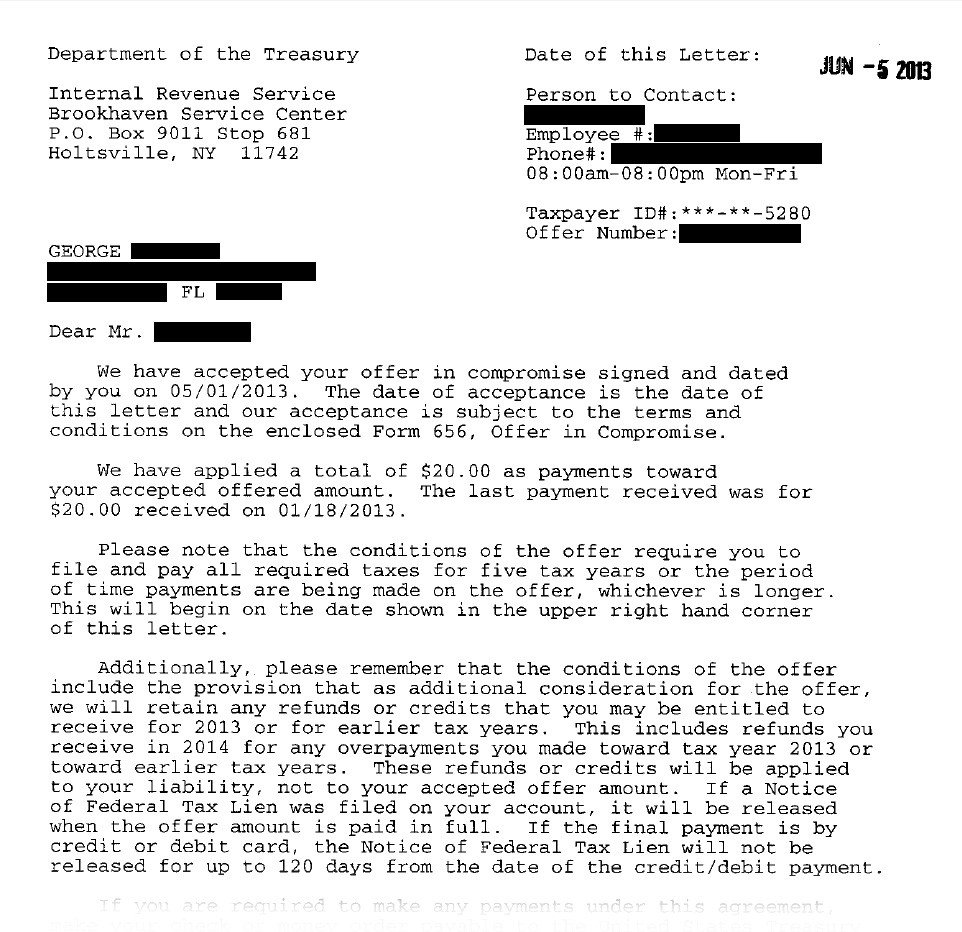
See the actual IRS acceptance letter

Find your fresh start

Book your free consultation and find out which program you qualify for.

Book a Free Consultation

Common questions about tax resolution

Straight answers to the questions we hear most. No jargon, no scare tactics.

How do I know if I qualify for an Offer in Compromise?+
The IRS evaluates your reasonable collection potential, meaning your income, necessary living expenses, and asset equity, to decide whether it will settle for less than you owe. Before we ever submit an offer, we run those same calculations ourselves, so you know whether an OIC is realistic or whether another program will serve you better.
Can you stop wage garnishments and bank levies?+
In many cases, yes, and often quickly. Once we file our representation with the IRS or state agency, we can negotiate a release or hold on enforced collection while a resolution is put in place. The sooner you act after receiving a notice, the more options remain open.
How long does tax resolution take?+
It depends on the path. Penalty abatement requests can resolve in weeks, installment agreements in one to two months, and Offers in Compromise typically take six to twelve months for the IRS to review. During your investigation phase we map out the expected timeline for your specific situation.
What if I haven't filed tax returns in years?+
You're not alone, and it's fixable. The IRS requires filing compliance before it will approve most resolution programs, so we start by preparing and filing your back returns, often replacing inflated substitute returns the IRS filed on your behalf, and then resolve the remaining balance.
Will I ever have to talk to the IRS myself?+
No. Once you sign a power of attorney (IRS Form 2848), all calls, letters, and negotiations go through our team. That's the point of representation: you get your life back while professionals who do this every day handle the other side.
Does state tax debt work the same way?+
Each state agency, like California's FTB, CDTFA, and EDD, or Arizona's DOR, runs its own versions of payment plans, settlements, and hardship programs with different rules than the IRS. We negotiate with state agencies regularly and know where their programs differ, which is often where the savings are.